Get Distinguished Name for a user
To get the distinguished name for a user, it isn’t enough to get an SPUser object. The distinguished name is the unique string for identifying a user in Active Directory (eg. CN=BeforeDAfter,OU=Test,DC=North America,DC=Fabrikam,DC=COM) Even using UserProfile object is not that clear. The distinguished name can be found in a property which can be retrieved with brackets: up[PropertyConstants.DistinguishedName]
public static string GetDistinguishedName(string login)
{
   var dn = "";
   UserProfile up;
   using (var site = new SPSite("http://dev"))
   {
      var serviceContext = SPServiceContext.GetContext(site);
      var upm = new UserProfileManager(serviceContext);
      var exists = upm.UserExists(login);
      if (!exists)
         upm.CreateUserProfile(login);
      if (exists)
      {
         up = upm.GetUserProfile(login);
         dn = up\[PropertyConstants.DistinguishedName\].Value.ToString();
      }
   }
   return dn;
}
```The code is simplified and doesn't contain any error handling. And a better handling of upm.UserExists must be implemented: If upm.CreateUserProfile(login) runs, it doesn't make it so quickly and the next step won't run (upm.GetUserProfile). If you are not working in SP Context, you can see the distinguished name for a user in Powershell:
import-module activedirectory $u = get-aduser administrator $u.DistinguishedName
jQuery timeago and the localization
 If you have used SPUtility.TimeDeltaAsString you must know how useful it is. There is also the jQuery plugin that can perform counting of time deltas and (!) translate it. jQuery timeago is available for many languages, Swedish among others:
// Swedish
jQuery.timeago.settings.strings = {
  prefixAgo: "för",
  prefixFromNow: "om",
  suffixAgo: "sedan",
  suffixFromNow: "",
  seconds: "mindre än en minut",
  minute: "ungefär en minut",
  minutes: "%d minuter",
  hour: "ungefär en timme",
  hours: "ungefär %d timmar",
  day: "en dag",
  days: "%d dagar",
  month: "ungefär en månad",
  months: "%d månader",
  year: "ungefär ett år",
  years: "%d år"
};
```The code is hosted on [Github](https://github.com/rmm5t/jquery-timeago). In order the time deltas to be localized in SharePoint a ScriptLink has to be used:
<SharePoint:ScriptLink ID=“timeagoLanguage” runat=“server” Language=“javascript” Name=“jquery.timeago.lang.js” Localizable=“True” LoadAfterUI=“True” OnDemand=“False” ></SharePoint:ScriptLink>
Google Analytics in Sharepoint
Google Analytics is a popular and mature tool for monitoring network activities on your site. Why not use it in Sharepoint? Dave Coleman and Mike Knowles provide good guides for doing that. There is a promising plugin to SP SPGoogleAnalytics which integrates both and provides an easy interface to put GA to your SharePoint installation and see the data directly on your intranet. It comes from codeplex: What do you think about spgoogleanalytics.codeplex? When I recently had to turn on Google Analytics on an intranet, I had no time for evaluating SPGoogleAnalytics, so I did the harder way: just put ga script in the end of a master page, just before ending </body> tag. But what if one has multiple masterpages? Is there a way to put GA in one step? Maybe a user control like Knowles suggests?
Subdomains for site collections
In order to be able to use subdomains for different sitecollections, we have to use hostheaders. Sharad Kumar provides a good example:
$w = Get-SPWebApplication http://sitename
New-SPSite http://www.contoso.com
    -OwnerAlias "DOMAIN\\jdoe" -HostHeaderWebApplication $w
    -Name "Contoso" -Template "STS#0"
```If we want to create, say http://rockets.contoso.com, we can run:
New-SPSite http://rockets.contoso.com -OwnerAlias “DOMAIN\jdoe” -HostHeaderWebApplication “http://sitename” -Name “Rockets” -Template “STS#0” -Language 1053
restart-service iisadmin
Working with web.Properties
Sometimes one may need more properties to track on a SPWeb beside Title and Description. One of the possibilities is to create a custom list (maybe a hidden one) with keys and values (Title and Value). It works fine. The good thing with it is also the possibility to change the key-value pair directly in the web interface. Another approach is to use web.Properties which is a Dictionary with key-values pairs. A simpler and neater solution: Here is a good motivation from the best sharepoint book Sharepoint as a Development Platform (p. 1043):
$.getJSON, jQuery.tmpl and _vti_bin
Javascript is very fast, responsive and unburdens the cpu at the server. Here I show a little example how to use jQuery.getJSON, jQuery.tmpl (wonderful plugin for rendering repeating data, repo hosted on Github) and REST-based service listdata.svc from /_layouts/_vti_bin/ folder. For this example I created a generic list “Contacts”, added two text fields Name and Phone. Add some phone numbers and try to go to /_vti_bin/ListData.svc/Contacts  If you get 404-error, install a ADO.NET Data Services v1.5 CTP2, as described at dotnetmafia. If you want to know more about how to sort and filter, skip and limit results, read more at nothingbutsharepoint. If you encounter problems, follow Michaël’s blog post and download and install Windows6.1-KB976127-v6-x64.msu (if you have Windows Server 2008 R2), or NDP35SP1-KB976126-v2-x64.exe (if you have Windows Server 2008). After installing the version of the System.Data.Services.dll file is 3.5.30729.5004 (Windows Server 2008 R2), and 3.5.30729.4466 (Windows Server 2008). Allright, the remainder is pure javascript. In order to get it working you have to run the script from the same domain, meaning you can’t run javascript to retrieve the data from a html-file from your home folder. Create a webpart and add it to your page.
Remove links to user profiles on list with javascript
Well, if you need remove links to user profiles, you can iterate all td-elements with class ms-vb-user using jQuery each function and remove a elements. Here is a little script:
$(document).ready(function() {
	$(".ms-vb-user a").each(function() {
	   var text = $(this).text();
	   var span = document.createElement("span");
	   var user = document.createTextNode(text);
	   span.appendChild(user);
	   var parent = $(this).parent()\[0\];
	   parent.removeChild(this);
	   parent.appendChild(span);
	});
});
```EDIT 2012-02-05 A much more better way to do it is [to use replaceWith in jQuery](http://stackoverflow.com/a/2409163/632117 "See a similar question and an answer on StackOverflow"):
$(".ms-vb-user a").each(function() { $(this).replaceWith(this.childNodes); });
Reset favicon cache
Favicon is one of the hardest. Ctrl-F5 doesn’t help. You can of course see the source, find the location of the favicon, click on it (if you use Firefox or Chrome), otherwise copy the url and paste it in the address bar. When you load it separately, the favicon cache is renewed. It works. But if you want to make it easier for your users, set a version to your favicon file in the masterpage:
Show files first in view
When you create an own view in schema.xml it is easy to show files first (Scope). It is quite useful if you want to show only few items on start page in xsltlistviewwebpart:
Scope="Recursive"
```Though there is a problem when you provision this list instance. Thanks to [a great post of Koen van der Linden about how to show files recursively](http://kvdlinden.blogspot.com/2010/04/schemaxml-onetxml-and-baseview-doesnt.html) it is no big deal to solve it. Just add the same scope to View element in the module in onet, which provisions your site:
<View List="$Resources:core,shareddocuments_Folder;" BaseViewID=“41” WebPartZoneID=“Middle” WebPartOrder=“2” Scope=“Recursive” />
Hide my site link with css
Want to hide my site link without disabling social features. 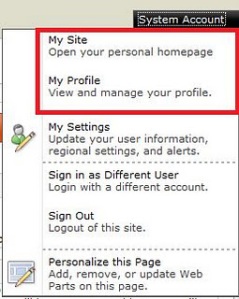 Well, the simplest way to do it is to use css:
#mp1\_0\_0\_Anchor { display: none; }
```If you want to hide my profile instead, just hide #mp1\_0\_1\_Anchor:
#mp1_0_1_Anchor { display: none; }
.ms-MenuUIUL li[text=‘My Site’] { display: none;}
##### Disable the my profile feature An even better solution is maybe to disable the ability to change the profiles. [Just remove the permission to "user personalization..." for All authenticated users in User Profile Service](http://blog.libinuko.com/2010/10/10/sharepoint-2010-howto-disable-my-site-and-my-profile-link/).
## Comments from Wordpress.com
####
[John]( "johnandrewdavies@hotmail.com") - <time datetime="2012-03-07 00:15:32">Mar 3, 2012</time>
Be careful this cannot be used, the classes for pop up menus are generated dynamically on the page, and that class can be applied to a number of menus I assume depending on the order which they load on the page, which isnt the same every time, so for instance this hides something in the site actions menu, or the new button on a library sometimes.
<hr />
####
[Brett Anderson](http://sharepoint2020.wordpress.com "brettando@live.com.au") - <time datetime="2012-05-02 06:13:05">May 3, 2012</time>
Hi, The amended solution does not work in IE7.
<hr />
####
[Fredrik]( "fredrik.eriksson234@gmail.com") - <time datetime="2012-03-09 15:27:24">Mar 5, 2012</time>
Thank you Anatoly, that worked perfectly in all browsers! I had problems with the first suggested solution, because it would hide other menu items, like "edit this page" from the site settings dropdown!
<hr />
####
[Anatoly Mironov]( "mirontoli@gmail.com") - <time datetime="2012-03-07 09:10:36">Mar 3, 2012</time>
You are totally right, John! I realized that too. Fortunately, I didn't need that then. But while using that I saw that sometimes Site Actions -Edit Page disappeared. These IDs are really generated dynamically. Thanks for your comment. I'll update my post.
<hr />
####
[vishal]( "vishals.shivan@gmail.com") - <time datetime="2012-03-07 07:27:54">Mar 3, 2012</time>
Hi Anatoly. Thanks for the solution. but the problem we are facing one problem after implementing this. Once we make this change and when login to the portal next time, the "Edit Page" link under site action menu is not getting displayed and the My Site Link is getting displyed. any suggestion?
<hr />
####
[Material SharePoint » Hide ‘My Site’ Link from Welcome User Dropdown Control](http://sharepoint.jsturges.com/2012/05/hide-my-site-link-from-welcome-user-dropdown-control/ "") - <time datetime="2012-05-12 17:45:13">May 6, 2012</time>
\[...\] of my enterprise level clients that we usually hide it all together! To do this, you can use an awesome CSS trick I learned from Anatoly \[...\]
<hr />
####
[Anatoly Mironov]( "mirontoli@gmail.com") - <time datetime="2012-03-07 09:24:39">Mar 3, 2012</time>
Hi Vishal. Unfortunately we cannot rely on these IDs, as John in previous comment mentioned, because these IDs are generated dynamically. I'll update my post. One possible solution would be use attribute selectors... Something like .ms-MenuUIUL li\[text='My Site'\] { display: none;}
<hr />
####
[jim]( "jim.omara@gmail.com") - <time datetime="2014-02-12 17:38:05">Feb 3, 2014</time>
.ms-welcomeMenu #mp1\_0\_0{ display:none; } .ms-welcomeMenu #mp1\_0\_1{ display:none; } .ms-welcomeMenu #mp1\_0\_2{ display:none; } .ms-welcomeMenu #mp1\_0\_3{ display:none; } .ms-welcomeMenu #mp1\_0\_4{ display:none; } .ms-welcomeMenu #mp1\_0\_8{ display:none; } .ms-welcomeMenu #mp1\_0\_9{ display:none; } these work for me.
<hr />
####
[Anatoly Mironov](http://chuvash.eu "mirontoli@gmail.com") - <time datetime="2014-02-12 23:20:59">Feb 3, 2014</time>
Thank you for sharing your solution. Appreciate.
<hr />